


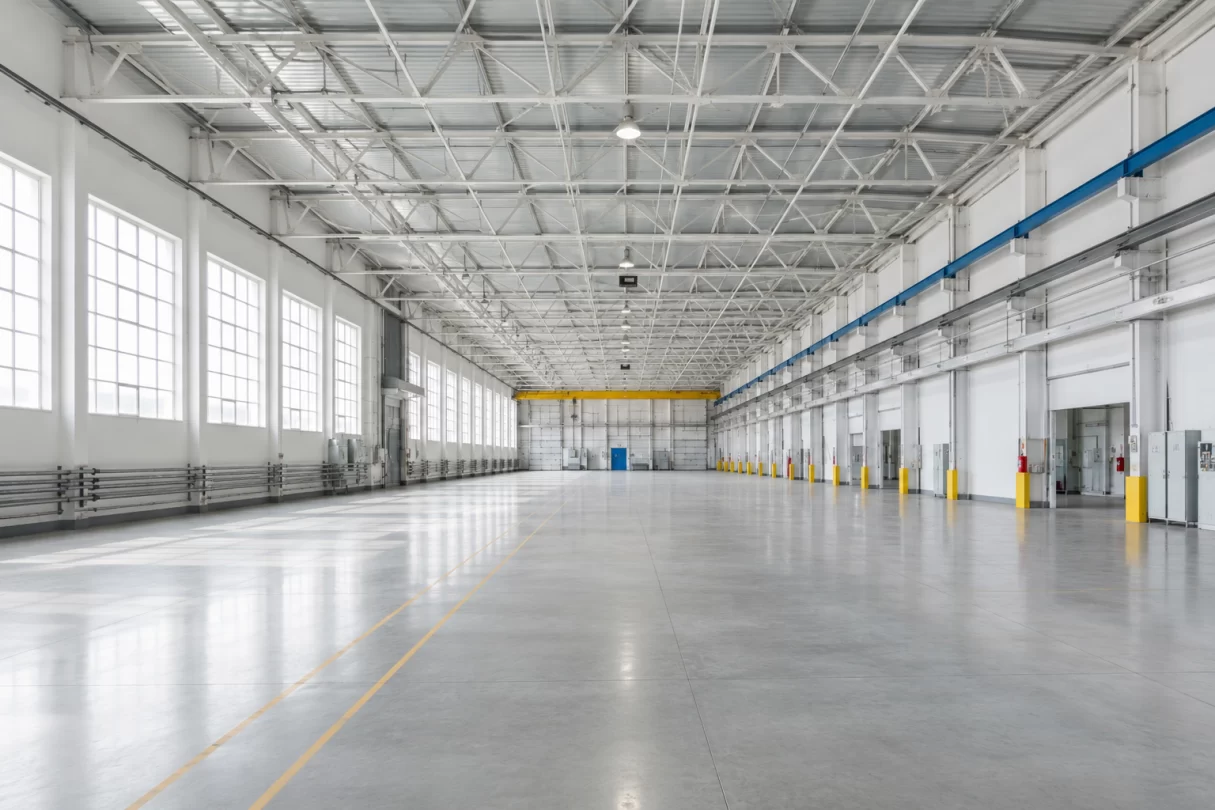
Keeping large factory and warehouse floors clean is about far more than appearances.
]Clean floors improve safety, protect equipment, support productivity and help create a healthier working environment. But warehouse floor cleaning at this scale needs a different approach to smaller commercial spaces. Many industrial sites still rely on outdated or inefficient cleaning methods that struggle to cope. This is partly due to the massive size of some of today’s warehouses and factories. They also struggle due to the type and quality of dust and dirt and that can settle in these environments as well as the everyday realities of modern operations.
This guide covers why large floor areas need a different cleaning approach. Where traditional methods fall short, how airflow and suction make the difference, and how to build a cleaning routine that works in real industrial settings.
Why Large Floor Areas Need a Different Approach
Factories and warehouses present unique cleaning challenges. Depending on the sector, floor areas can be vast, often uneven and subject to constant traffic from forklifts, pallet trucks and footfall. This grinding action breaks down debris into fine dust, which can spread across the site and settle on stock, machinery and racking.
Unlike small commercial spaces, industrial environments can’t afford cleaning methods that are slow, repetitive or disruptive. Cleaning needs to be fast, effective and capable of removing dust fully rather than simply pushing it around. A method that works in an office or retail unit quickly becomes inefficient when scaled up to thousands of square metres of concrete flooring.
In terms of pure operational reality, cleaning that takes too long increases downtime, interrupts workflows and pulls staff away from productive tasks. So for large floor areas, efficient warehouse floor cleaning has to be fast, thorough and fit around operations.
Limitations of Traditional Cleaning Methods
Many factory or warehouse sites still depend on manual sweeping or basic mechanical sweepers to cover large areas. While these methods may seem cost‑effective (or put another way ‘cheap’) at first glance, they come with significant drawbacks.
For example, manual sweeping is slow, physically demanding and inefficient. It stirs up fine dust into the air rather than removing it, leaving surfaces looking clean but still contaminated. This airborne dust can affect air quality, settle back onto floors or equipment and create ongoing cleaning requirements with little long‑term benefit.
Mechanical sweepers improve speed but share similar limitations. Brushes tend to lift and redistribute dust rather than extracting it fully, which can be a problem in environments where fine dust is the main concern. Over time, this can lead to persistent dust build‑up and a false sense of cleanliness.
A detailed comparison of these approaches is explored in Big Brute’s article Industrial Vacuum Cleaner vs Sweeper: Which Is Better for Warehouse Cleaning?. This highlights why extraction, rather than displacement, is critical for industrial floor cleaning.
The Role of High Airflow in Floor Cleaning
One of the most important factors in the overall effectiveness of large‑area cleaning is airflow. High airflow allows dust, grit and debris to be lifted and removed completely from the floor surface, including fine particles that brushing alone cannot handle.
Industrial vacuums designed for large floor areas such as the Big Brute use suction-based airflow. These work by pulling debris into the machine, preventing dust from becoming airborne. This results in cleaner floors, improved air quality and a safer working environment for staff.
High airflow also allows for wider floor tools, enabling operators to clean broad swathes of floor at walking pace. This significantly reduces the time required to clean large spaces and makes the process less physically demanding. Rather than repeated passes with limited results, powerful levels of suction create powerful airflow. This achieves a deeper clean in fewer passes.
Equipment Options Compared
Choosing the right equipment is essential for efficient floor cleaning at scale. Brooms, sweepers and industrial vacuums all have a place, but their effectiveness varies depending on the environment and type of dirt.
For large, dusty factory and warehouse floors, industrial vacuums specifically designed for floor cleaning offer the greatest advantage. Models such as the Big Brute Warehouseman and Economy Warehouseman are built to clean wide floor areas efficiently while capturing fine dust rather than redistributing it.
The Warehouseman is designed for heavy‑duty environments where dust levels are high and cleaning is frequent. The Economy Warehouseman offers a lighter‑duty option for sites that still require strong suction but with lower operational demands.
You can read about the differences in our previous article on the Warehouseman and Economy Warehouseman range, which aims to help businesses choose the most suitable solution.
Using the right equipment reduces cleaning time, operator fatigue and long‑term maintenance issues across your factory or warehouse site.
Building an Efficient Warehouse Floor Cleaning Routine
For all its benefits, even the best equipment needs to be part of a well‑planned routine. With large floor areas, consistent warehouse floor cleaning matters more than occasional deep cleans. Regular vacuum cleaning removes dust before it accumulates, reducing the effort required each time.
An efficient routine aligns cleaning with operational patterns, targeting quieter periods or shift changes to minimise disruption. It also ensures that staff are trained to use equipment properly so that cleaning is done thoroughly in one pass rather than through repeated corrections.
From a business perspective, efficient cleaning directly affects productivity. Time spent re‑cleaning floors, dealing with dust‑related equipment issues or managing health and safety concerns all adds up. We explore this in our blog Industrial Vacuum Cleaner vs Manual Cleaning: Is Automation Worth the Cost?. In this article we talk about how effective cleaning reduces downtime and frees staff to focus on productive work.
For more on how Big Brute tackles warehouse floor cleaning, see our warehouse floors application page.
Conclusion – Clean Faster, Safer and More Effectively
The best way to clean large floor areas in factories and warehouses is to move beyond sweeping and surface‑level cleaning. Powerful, suction-based high‑airflow industrial vacuum cleaning removes dust fully, improves safety and dramatically reduces cleaning time across large spaces.
By using equipment designed specifically for industrial floor cleaning and integrating it into a consistent routine, businesses can protect their floors, their staff and their productivity.
If you’re looking for equipment to help you improve how your factory or warehouse floors are cleaned, speak to Big Brute today. Whether you need advice on the right machine, want to reduce cleaning time or are ready to upgrade your current approach, Big Brute’s range of industrial vacuum cleaner solutions is built to deliver reliable results where it really matters.
